
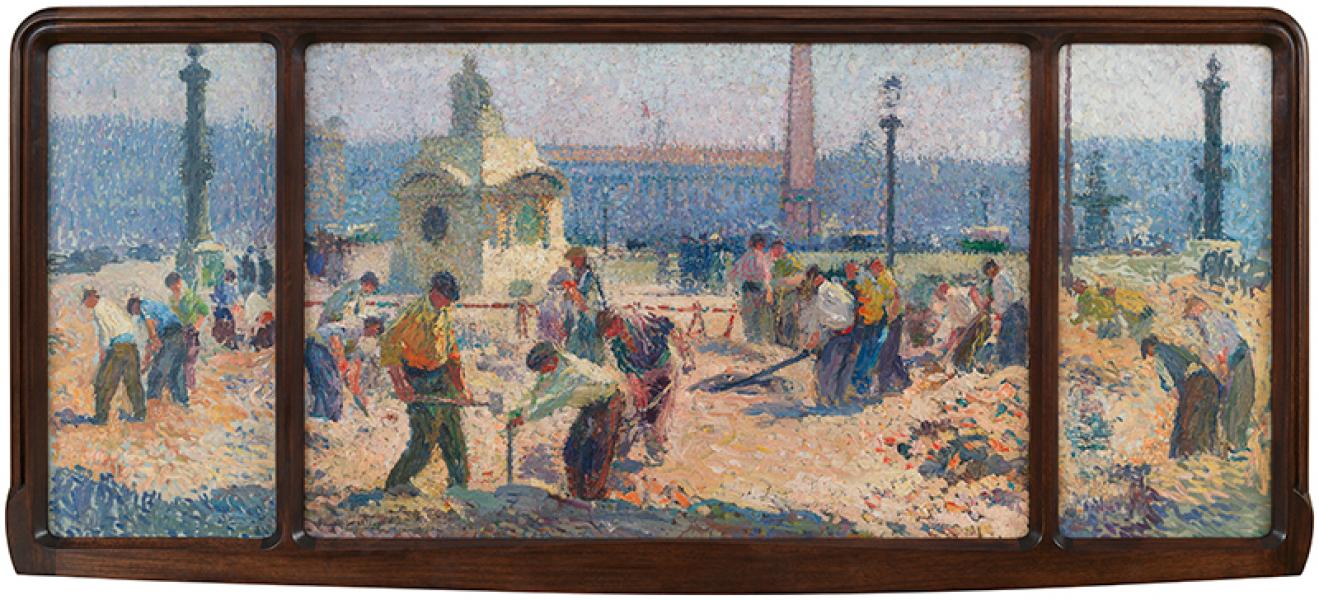
Les travaux de la place de la Concorde à Paris, circa 1925
Three oil on canvas panels forming a triptych, signed lower left on the central panel, overall dimensions: 26.4 × 63.0 in. (67 × 160 cm) (individual panels: 26.4 × 12.6 in. (67 × 32 cm), 26.4 × 38.6 in. (67 × 98 cm), 26.4 × 11.8 in. (67 × 30 cm))
67 x 160 cm
Provenance:
Estate of Cyrille Martin
Related work:
The work we present is a study for one of the triptychs from the monumental decorative cycle La France laborieuse se présentant devant le Conseil d’État, General Assembly Hall, Conseil d’État, Paris.
Notice of inclusion in the archives intended for the preparation of the catalogue raisonné of Henri Martin, currently in preparation by Marie- Anne Destrebecq Martin.
La France laborieuse se présentant devant le Conseil d’État is the formal title of the decorative ensemble to which the work we present relates. Preserved in the artist’s studio, this triptych constitutes a study for part of the programme devised by Henri Martin for the Conseil d’État, the highest administrative court in France, which occupies one of the wings of the Palais-Royal in Paris.
As early as 1914, the Minister of Public Instruction and Fine Arts had commissioned the artist to create a large decorative cycle intended for the General Assembly Hall. The decorative programme, conceived in response to the archi- tectural requirements of the space, consists of four triptychs in which a central panel is flanked by two narrower wings. In total, twelve paintings were thus conceived to engage in dialogue within this eminently representative chamber and to depict, facing the Councillors of State as they sit and deliberate, France at work.
On one side, the port of Marseille and its teeming activity embody trade and international exchange, while opposite them agricultural labourers—men and women bent under the task—are shown working the nourishing land. At the head of the hall, behind the presidium, intellectual labour is expressed through sobriety: a solitary, elderly, bearded man walks through a pine wood, absorbed in thought—an image emblematic of the decisions made within this chamber. Finally, the last triptych, which occupies the far end of the hall, constitutes the final version of the painting we present here.
After agricultural labour, commercial activity and intellectual work, it remained to evoke the urban sphere. The capital and its major public works undertaken during post-war reconstruction provided the subject. On the Place de la Concorde, workers are busy at their tasks. In the summer of 1921, press photography bore witness to a site in full activity: the paving of the square, damaged by years of conflict and increasingly worn by the growing number of vehicles, was being redone. Henri Martin likely observed the workers at length and, as with each major composition, first meticulously arranged the setting and sketched all the figures, studying their positions and gestures at work with a confident pencil line, emphasizing details down to the tools themselves.
Henri Martin was no stranger to large-scale decorative commissions, and when he undertook this project for the Conseil d’État, he already possessed considerable experience in the field. The Paris City Hall, those of Tours, the Capitole in Toulouse, the Sorbonne, the Town Hall of the 10th arrondissement, the Élysée Palace... the artist had become a privileged interpreter for public authorities. While continuing his easel painting, he pursued a distinguished career as a mural painter—although it should be specified that he never executed frescoes in the strict sense, but rather decorative panels autonomous from their architectural support.
Although this commission dates from before the war, it was only much later, in the mid-1920s, that Henri Martin’s paintings were finally set into the wood panelling, replacing a red and gold hanging that was perhaps deemed too silent for such a space. In 1926, the triptych Les Travaux de la place de la Concorde was presented to the public at the Salon before taking its place permanently in its prestigious setting, where it can still be admired today—within this hall where, whichever direction one turns, Henri Martin accompanies the deliberations of the Council.