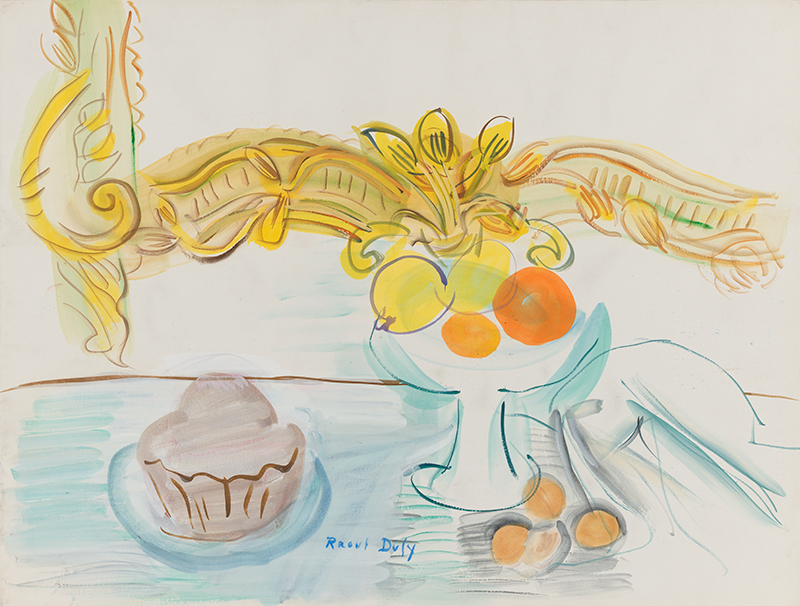
Nature morte à la brioche et au compotier, 1947
Watercolor on paper, signed lower center
50 x 66 cm
Provenance :
Galerie Louis Carré
Exhibition :
Exposition de natures mortes, de Géricault à nos jours, Musée d’art
et d’industrie de Saint-Étienne, 24 April – 30 May 1955, no. 50.
Literature :
Fanny Guillon-Lafaille, Catalogue raisonné des aquarelles, gouaches et pastels de Raoul Dufy, vol. II, Louis Carré, Paris, 1981, no. 1461, p.145.
Certificate issued by Fanny Guillon-Lafaille.
Dufy seemed to take equal pleasure in drawing and painting a wide variety of subjects: a corner of a table, a nude, a seascape, a landscape, a crowd… all were, without hierarchy, equivalent sources of inspiration for him. Everything in his daily life was a spectacle, and everything became a pretext for drawing and painting.
Within his highly distinctive idiom, which delights in introducing multiple graphic signs to punctuate space and does not hesitate to incorporate elements more readily associated with decorative language, Dufy offers us the joyful presence of this Still Life with Brioche and Compotier.
In the second half of the 1940s, a period that had barely seen the end of the war and its privations, painting a brioche undoubtedly carried a very different meaning from that it might hold for a French painter today, accustomed never to having lacked such comforts. At the time when Dufy produced this watercolor, this brioche—plump and generously swollen—was likely a celebration in itself, symbolizing the return of more clement times. Proudly enthroned on the table where the compotier displays its fruits—bright lemons and oranges—the brioche is crowned by a golden ribbon adorned with vegetal acanthus motifs, bursting forth like a natural extension of the fruit itself.
Several still lifes by the artist feature this same element, within varied compositions (one of which is housed at the Art Institute of Chicago), where the compotier, always present, bears different fruits according to the season. In turn, the brioche is replaced by cutlery and a napkin, almonds and a jug, or other fruits.
On closer inspection, this decorative frieze appears to evoke a gilded frame or a mirror, perhaps hanging on the dining-room wall. Certain compositions describe this element in greater detail, while in others from the same series it gradually assumes a more allusive, freer and deliberately decorative dimension. Becoming a ribbon, a pediment, or a stylized vegetal incursion, this element—surprising at first glance—ultimately illuminates the full sensitivity of the artist.