Éric Cantona was born on May 24, 1966, in Marseille and grew up in the Caillols district, within a family of Sardinian, Italian, and Catalan origins, alongside his two brothers.
He discovered football at the age of six with Sports Olympiques Caillollais, first as a goalkeeper before switching to striker in order to become more actively involved in the game. Quickly noticed for his talent, he began his professional career in the early 1980s with AJ Auxerre.
It was during this period that his career truly took off. He left a lasting mark on every club he played for, the three most significant chapters being Olympique de Marseille and then England, where he distinguished himself successively at Leeds United and Manchester United.
Known for his outspoken nature and uncompromising personality, he quickly became one of the most iconic footballers of his generation, leaving a unique imprint on the sport.
While football is naturally the first thing that comes to mind when speaking of Éric Cantona, the man is far more than that. Actor, writer, singer, performer — he has constantly enriched his path by exploring new horizons. Among these passions, painting perhaps occupies the most intimate place.
This attraction to pictorial art likely comes from his father, a nurse by profession who painted alongside his working life. An influence that never left him, as Cantona was already exhibiting his own paintings in Marseille as early as 1988. His works, described as resolutely expressionist, stand out through their chromatic power and emotional intensity. Around the same period, he also began collecting art, acquiring his first post-impressionist paintings — cultivating a passion for the eye and for observation that continues to this day.
His commitment to art extends beyond practice and collecting: he has also become one of its ambassadors, notably through his role as honorary president of the Festival du Dessin d'Arles, whose fourth edition he actively supports.
It was therefore only natural that we turned to Éric Cantona to take part in this singular project, combining pictorial expression with Marseille’s collective memory — a project he embraced enthusiastically. Armed with markers, a hammer, and a chisel, he appropriated a prison door in order to engrave powerful words into it, creating a gesture both raw and poetic, unmistakably in his own image.
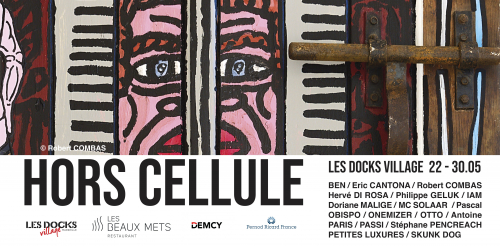
HORS CELLULE
22 May 2026 - 30 May 2026