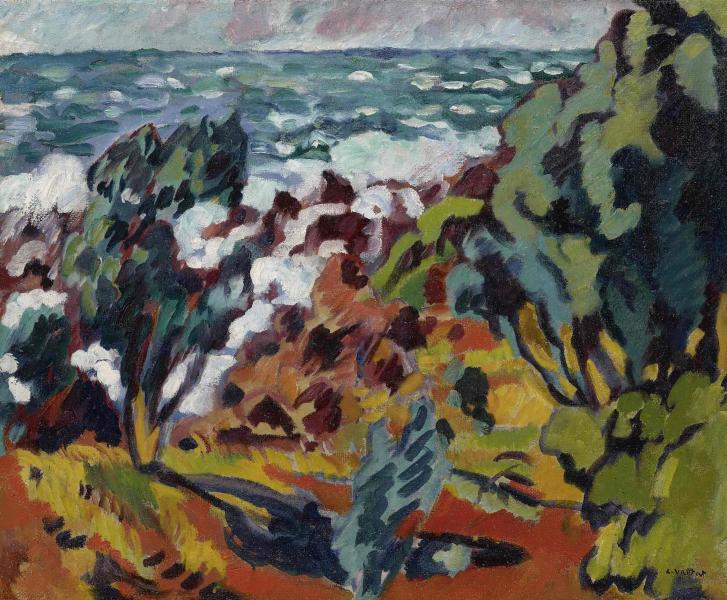
Les rochers rouges à Agay, grand vent, circa 1910
Oil on canvas, signed lower right.
60 x 73 cm
Provenance:
Collection of Marie-Lucie Nessi Valtat, until the 1960s
Galerie Brame et Lorenceau, Paris
Private collection, France
Galerie Alexis Pentcheff, Marseille
Private collection, France
Certificate confirming inclusion in the catalogue of the works of Louis Valtat, issued by the Archives of the association Les amis de Louis Valtat.
Much ink has been spilled over the past decade in an attempt to settle the question of whether Valtat was, or was not, a Fauve.
When considered in isolation, his works can indeed be disorienting for art historians, all the more so as the artist was not a theorist: he left no statements that might help guide his future exegetes. Depending on the period and the work, Valtat seems to hover at the margins or in the wake of the Nabis, the Neo-Impressionists, or the Fauves—but never at the very eye of the storm.
To summarise a few indisputable facts: Valtat exhibited as early as 1893 at the Salon des Indépendants, and in 1905 he was present at the Salon d’Automne in Room XV, alongside Friesz, Jawlensky, Rouault, and Kandinsky, and not in the Fauves’ room (the famous Room VII).
The journal L’Illustration (4 November 1905) nevertheless pointed out an affinity between the artist and the group by reproducing, on the same page as Matisse’s celebrated Femme au chapeau a seascape by Valtat that had caused no small scandal.
Valtat was not, however, personally connected to Matisse, who was born the same year as he was. They never exhibited together, and his affinities lay rather with the Nabis, or with Signac and Luce, with Renoir, and also with Toulouse-Lautrec, with whom he worked for a time in the mid-1890s.
It was Vollard, the dealer of the Fauves, who from 1904 represented Valtat exclusively. Until 1911, he purchased the entirety of the artist’s output and oversaw its submission to the various exhibitions, before eventually bringing the collaboration to an end, finding it no longer profitable.
Valtat lived and worked largely away from the capital. Between 1895 and 1897, he stayed around the Arcachon Bay and Banyuls in order to treat his tuberculosis. This period appears to have been the most experimental, during which he fused and reworked all the pictorial languages he had assimilated up to that point. These explorations continued in the Mediterranean, at Anthéor, where he built a house in 1899 and remained until the war.
Our painting, probably dating from around 1909–1910, presents a powerful gust of wind sweeping along the coast. Any lingering Neo-Impressionist temptation has here been abandoned. In a tightly framed composition with a high horizon, outlined masses clash violently against the red rock in a frenetic rhythm. Colour, intense and assertive, structures the painting more than drawing. Everything appears in motion, subjected to the force of a raging wind that further heightens the contrasts. The painting is powerful.
The surface of the canvas becomes a battlefield in which opposing forces struggle and collide. The composition wavers, equilibrium breaks down, and the viewer can thus truly experience, in this profoundly sensory painting, the effect of the wind upon the maritime landscape.