The Pavillon de la Reine Jeanne, an Art Gallery in Malmousque, Marseille
A historic house on the little port of Malmousque, transformed into an art gallery
In autumn 2023, Galerie Alexis Pentcheff left 131 rue Paradis, an address well known to collectors in central Marseille, where it had been based for nearly fifteen years, and moved into a historic building overlooking the sea in the Malmousque district (7th arrondissement of Marseille).
At the heart of this little port tucked beneath the Corniche Kennedy, where the spirit of the traditional seaside cabanons of the last century lives on, the new gallery enjoys privileged access to the sea and offers an ideal setting for paintings.
Only the location has changed: the gallery’s team remains the same, as does its specialism, modern French painting and works on paper from 1850 to 1950, with particular attention to the artists inspired by the light of the Mediterranean.
From now on, you are welcome to visit us at 10 chemin du Génie, in Malmousque, and discover the gallery’s exhibitions at the Pavillon de la Reine Jeanne, a former seaside residence fully restored and reimagined as an art gallery.
The history of the house: from restaurant to art gallery
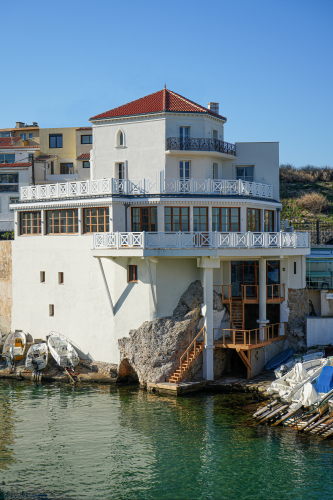
Overlooking the little port of Malmousque, the Pavillon de la Reine Jeanne was built by the architect Jean-Pierre Costa between 1888 and 1908. Once completed, the house was first named Pavillon Saint-Louis. On the builder’s death, his daughter inherited it; she lived there for a while before letting it. Between 1914 and 1923, the house was occupied by, among others, the director of a silk mill, and was temporarily known as the “Pavillon de la Fileuse” (the Spinner’s House).
The building was sold for the first time in 1926, then requisitioned by the Germans in 1940.
In 1944, Mr Pieri acquired it. A goldsmith and the founder of the Piery brand, established in 1930, the new owner, an entrepreneur at heart, decided to open a seafood restaurant there: La Reine Jeanne. With its large terrace overlooking the Mediterranean, its colourful parasols and its lobster tank, the restaurant attracted an exclusive clientele who arrived by boat.
Later, Jean Pieri, absorbed by the growth of his jewellery business, gave up the restaurant. For a time, the house was lived in only part of the year, until his daughter and son-in-law settled there to raise their three daughters in peace. Once their daughters had left, the couple stayed on, happily welcoming their grandchildren for the holidays, but with age the upkeep of the house became a burden. They placed their trust in us to give a new life to this historic Malmousque building, where we decided to set up the gallery and host new exhibitions.
The restoration of the Pavillon de la Reine Jeanne
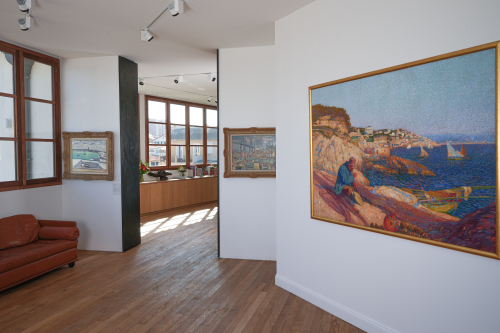
Major structural work was needed before the house could safely welcome the public again. The sea had taken its toll, and it took nearly two years of renovation, not counting lengthy preliminary studies and many administrative hurdles, to restore the house to the appearance it may have had in the early 20th century, based on archive photographs, down to the façade mouldings and the decorative lambrequins. The architect Bertrand Guillon and his team oversaw the project.
The entire ground floor is devoted to the gallery: a space of about 200 m², much of it given over to hanging works, with the sea as a backdrop.
The Pavillon de la Reine Jeanne welcomes the public during exhibitions, and by appointment the rest of the year: the people of Marseille as well as collectors and art lovers passing through the city who wish to discover the gallery’s exhibitions and collections.
From time to time, the gallery also serves as a location for film shoots and photo shoots for prestigious brands, drawn by its enchanting maritime setting.