
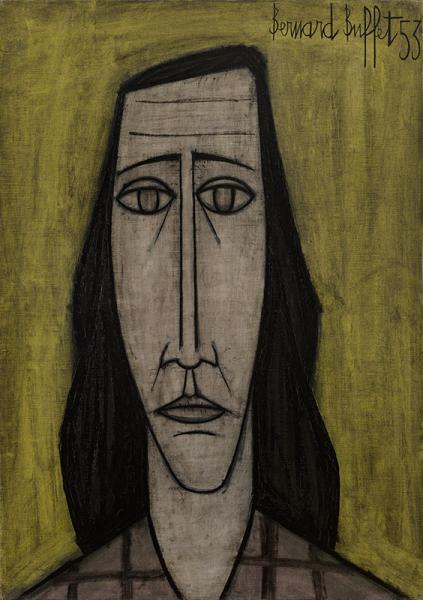
Tête de femme, 1953
Oil on canvas, signed and dated in the upper right corner.
65 x 46 cm
Provenance :
Galerie Drouant-David, Paris
Jean Jansem Collection, France
Galerie de Souzy, Paris
Private collection, France
Literature :
Bernard Buffet, Catalogue raisonné, vol. 2, 1954-1958, Fonds de Dotation Bernard Buffet, 2019, reproduced on p. 363.
Certificate of authenticity issued by Galerie Maurice Garnier.
In 1953, Bernard Buffet was already a recognised artist, despite his young age. He had gained institutional recognition by winning the Prix de la Critique in 1948 and, the following year, at barely twenty-one years old, by entering public collections. He had also signed an exclusive contract with a major gallery, which shielded him from financial concerns. Recognised as a counter-figure to the rise of abstraction, his painting embodied the post-war austerity that permeated French society, still deeply marked by the years of conflict.
Buffet was well connected within the cultural circles of the capital. Yet, in the early 1950s, he no longer worked in Paris: he lived with his companion Pierre Bergé in a former shepherd’s cottage in Nanse, near Manosque, where their friend, the writer Jean Giono, was also based. This rural environment led him to take an interest in the Provençal landscape, but within this retreat it was above all in the studious solitude of the studio that Buffet pursued his research.
Still lifes continued to occupy him, with their restrained chromatic range, lean materiality and silent yet nervously drawn austerity, placing the canvas under palpable tension. This aesthetic found an echo in his work on portraits, as if the logic of observing objects were transferred to the human figure.
Using a limited palette and a tightly cropped composition that eliminates all narrative context, the portraits of this period—such as the one presented here—take on the dimension of totemic figures. Frontal composition is fully embraced, and all attention is focused on the face, on that characteristic expression which places the portrait within an existential register. In this way, the painter turns his models, regardless of gender, into icons of modern despair.
Repeating the motif almost obsessively, Buffet produced several nearly identical canvases, with only slight variations of line that modulate the intensity of the figure. Almost meditative works—or rather works of concentration—these paintings fix the artist’s grammar and serve as a formal reservoir for the major narrative cycles that would follow.