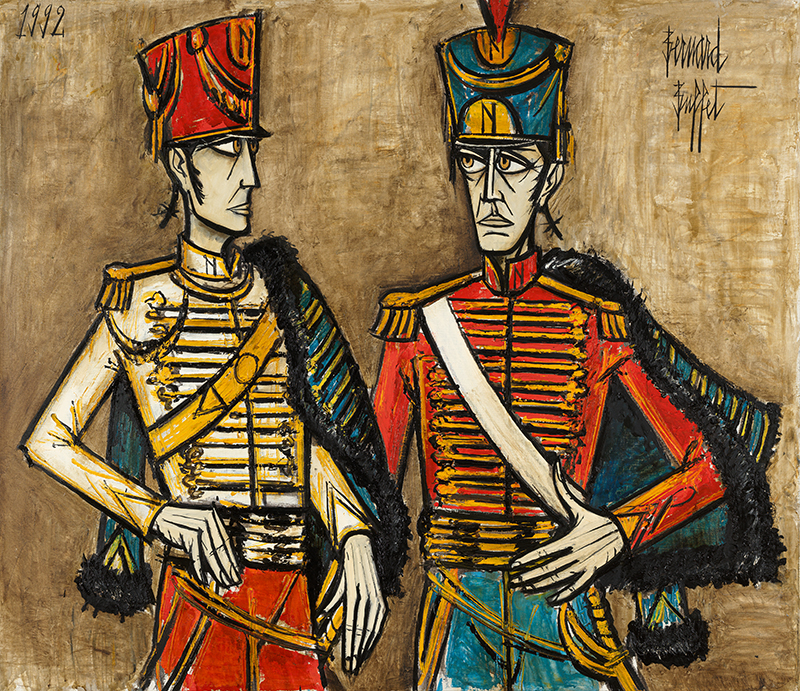
Deux officiers d'Empire, 1992
Oil on canvas, signed upper right and dated upper left.
125 x 145 cm
Provenance :
Estate of Bernard Buffet
Certificate of authenticity issued by the Bernard Buffet Endowment Fund.
It is unusual for an artist to have been represented throughout his career by the same gallery, and even more so to have been the only artist represented by that gallery.
Each year, in the month of February, the harvest was brought in: Bernard Buffet would invariably present at the Galerie Maurice Garnier the work produced over the preceding months.
This mode of operation thus followed annual cycles, which were also thematic: Landscapes (1950s), The Horrors of War (1955), The Circus (1956), New York (1959), Nudes (1980), Japan (1981), Self-Portraits (1982), The Netherlands (1986), Views of Venice (1987), The Odyssey (1994), The Seven Deadly Sins (1995), Beijing (1996), Regattas (1997), The House (1998), My Monkeys (1999)…
Often, Annabel Buffet wrote the preface to the exhibition catalogue.
The catalogue for The Empire, or the Pleasures of War (1993) is blue and gold, solemn in tone, recalling the uniform of the Imperial Guard.
Only seven paintings from the series are reproduced there—large-scale works, all violently charged with jouissance.
As early as 1955, Buffet had already explored The Horror of War. Drawing on painful memories, he brought back to the surface the worst evils of the Second World War, scarcely a decade after its end.
Thirty-eight years later, he devoted a new series of paintings to the madness of humankind. The Gulf War or the conflicts in the Balkans could easily have provided contemporary examples in the early 1990s. Yet the painter chose to adopt historical distance.
He leaps back in time, to the Napoleonic era, to state more clearly that nothing has changed: whether one wages war in yesterday’s uniform or today’s, whether heads are severed by the sabre, throats cut by the bayonet, or bodies mown down by machine-gun fire. Cannon and shell have the same reach, and the rape of camp followers remains a grim constant.
Blood spurts, heads fall, arms and legs are severed, eyes gouged out, bodies torn apart: ferocity is at work. At the heart of this brutality, this masculine bestiality, sexual impulse exults; absent from the battlefield, women nonetheless re-enter the painting as figures destined to satisfy the soldiers’ desire—for their greatest misfortune.
Yet there are also those richly adorned, colourful uniforms, the panache, the trumpets and martial fanfares, and that spectacle of cruelty which delights a part of us: the pleasures of war.
In his maturity, the painter fully grasped that there exists an incorrigible part of the human being that feeds as much on the exercise of violence as on its representation.
The child who once played with toy soldiers has not forgotten that thrill which leads from horror to pleasure. Some of us are driven to action; others settle for voyeurism, unable to avert their gaze from the spectacle, whether pictorial, cinematic, or drawn from current events.
Our painting contains all of this fierce tension, once we know that it belongs to this series within the artist’s oeuvre. The officers pose obediently and gravely in their dress uniforms, a prelude to the storm. But the dazzling brilliance of the military uniform—however seductive in its colours and details, in which the painter revels—must not obscure the purpose for which it exists. Soon, inevitably, our brave officers will be smeared with blood. No doubt, their heads will fall.