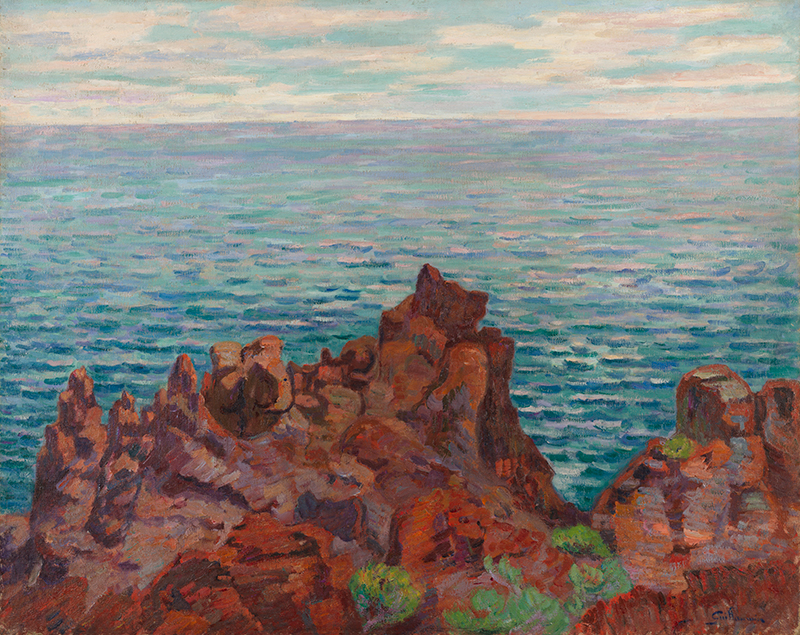
Les Roches rouges, pointe de la Male Raigue, avril 1899
Oil on canvas, signed lower right.
74 x 93 cm
Provenance :
Probably the collection of Georges Feydeau until 1901 (a painting bearing the same title and identical dimensions is described, but not illustrated, in the sale catalogue of the modern paintings from the Feydeau collection, Drouot, 11 February 1901, n°51)
Collection Pierre Decourcelle
Sale of the modern paintings from the Pierre Decourcelle collection, Drouot, Paris, 16 June 1926, no. 40
Private collection, France, since 1994
Sale Sotheby’s, Paris, 24 March 2017, lot 51
Private collection, France
Certificate of inclusion in the second volume of the Catalogue raisonné of Armand Guillaumin, currently in preparation by the Guillaumin Committee (Stéphanie Chardeau-Botteri, Dominique Fabiani, Jacques de la Béraudière).
Armand Guillaumin fully belongs to the generation of the Impressionists. Born in 1841, only one year apart from Claude Monet and two from Alfred Sisley, he also shares the same year of birth as Pierre-Auguste Renoir.
At the Académie Suisse, where he attended evening classes, he became acquainted with Renoir, as well as with Camille Pissarro, who was slightly older than they were. It is Pissarro to whom Guillaumin is more often compared, as their respective approaches to landscape painting share a number of common characteristics.
Although he painted with unwavering dedication throughout his life, Guillaumin was nonetheless compelled, for much of his career, to hold modest and subordinate jobs. It was only later — seemingly thanks to a substantial lottery win — that he was finally able to devote himself fully to painting.
An exhibition was devoted to him by the Bernheim Gallery in 1906, followed two years later by one at the Rosenberg Gallery.
At Agay, where he painted regularly from 1895 onwards, Guillaumin was struck by the violence of contrasts. The ancient Esterel massif, a volcanic formation dating back to the Primary era, owes its unusual colouring to amaranth rhyolite, the rock from which it is composed, exceptionally rich in phenocrysts.
The perception of the rocks plunging into the sea thus varies greatly according to atmospheric conditions and the time of day. From a pinkish orange hue, shifting in intensity from early morning, they glow with fiery redness as evening falls.
This moment naturally became a favourite of painters — and later photographers — who sought to capture the striking, almost unreal contrast between the vivid orange emerging from the land and the deep ultramarine blue of the Mediterranean waters.
Paintings of the Esterel rendered in violent, saturated tones have sometimes led Guillaumin to be regarded as close to the Fauves. Yet at Agay, the artists painted only what they saw. The rocks truly blaze above the sea, and, as in the work of Louis Valtat at roughly the same period, Guillaumin’s palette faithfully reflects this reality.
In truth, his approach remains fundamentally Impressionist, attentive to the effects of changing atmospheric conditions on the landscape.
On the reverse of the stretcher of our painting, the artist noted :
“La Pointe de la male raigue avril 99 le matin”.
Between Agay and Saint-Raphaël, this rocky outcrop, located in a small cove at Cap du Dramont, is today more commonly known as Mare Règue.
Our painting, which belonged to the collector Pierre Decourcelle until the mid-1920s, was probably previously owned by Georges Feydeau. A description of a work of identical format and bearing the same title appears in the catalogue of the sale of his collection of modern paintings in 1901, under lot no. 51: “Aggressive, bristling with angles, the rock juts out above the waves. A few sparse grasses in the foreground. And, stretching to the limitless horizon, the sea, of a deep green, softened in the distance into the tender blue of a sky streaked with thin milky clouds.”
In the absence of an illustration, however, it is difficult to establish this identification with absolute certainty.
Although Guillaumin has sometimes been viewed as a precursor of Fauvism, he is probably — at the very least — the most colour-driven of the Impressionists, favouring in this respect the lesson of Paul Cézanne over that of Edgar Degas. He is undoubtedly also among the most modern of them, daring not only in his
use of colour but also in his bold compositional framing.
Guillaumin was not, however, the most celebrated artist of his generation. Even today, his recognition remains hesitant. Since his death, little justice has been done to his work. Museums have shown limited interest in reassessing his contribution, and he has most often been mentioned only in the context
of group exhibitions. The monographic exhibitions devoted to him have largely resulted from private initiatives, such as the exhibition held at the Galerie Gérard in 1941, or more recently at the Galerie Lévy in the early 2000s.
Through the audacity of his palette, the modernity of his framing, and his fidelity to the principles of Impressionism, Armand Guillaumin today emerges as one of the most singular — and paradoxically one of the most overlooked — figures of this movement that laid the foundations of modern painting.