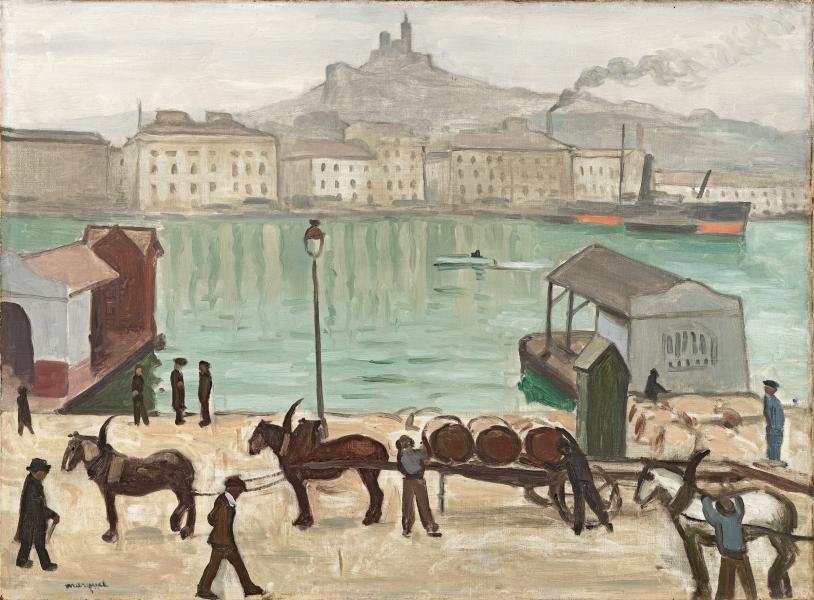
Marseille, le port, Notre-Dame-de-la-Garde, hiver 1915-1916
Oil on canvas, signed lower left.
54.20 x 73.30 cm
Provenance:
Galerie Druet, Paris, acquired from Marquet on 4 February 1916
Collection of Miss Marthe Dron, France, 15 April 1916
Collection of Mr Parent, Paris
Galerie Druet, Paris, May 1925 (inventory no. 11031)
Collection of G. Descours, France, acquired from Galerie Druet in November 1927
Galerie Schmit, Paris, 1967
Private collection, c. 1967
Cornette de Saint-Cyr sale, Paris, 17 June 2021, lot no. 100
Galerie Alexis Pentcheff, Marseille
Private collection, France
Exhibitions :
Albert Marquet, Galerie Eugène Druet, Paris, 22 November – 3 December 1920, no. 7, titled Marseille, Notre-Dame-de-la-Garde.
Buenos Aires, Argentina, Amigos del Arte, 1926.
Exhibition of Modern French Art at the Ateneum, Ateneum Art Museum, Helsinki, Finland, 6–30 March 1927; Kunstnerforbundet, Oslo, Norway, April–May 1927, no. 72.
Marquet, 1875–1947, Galerie Schmit, Paris, 17 May – 17 June 1967, reproduced in the exhibition catalogue, p. 55, no. 43 (dated 1917).
Inaugural exhibition at the Pavillon de la Reine Jeanne, Galerie Alexis Pentcheff, Marseille, 3 October – 15 November 2023, reproduced in the exhibition catalogue, p. 89, no. 16.
Certificate of inclusion in the artist’s digital catalogue raisonné issued by the Wildenstein Plattner Institute.
From his master Gustave Moreau, Albert Marquet retained, more than academic lessons, a taste for the eclecticism of sources. He probably discovered through him the power of Japanese prints—unless he was drawn there by his fellow student companions to the Bing Gallery. It must be said that the artistic Paris of his youth was steeped in Japonisme, which fascinated painters in particular through this discipline that praises, in a precise gesture, both detail and economy.
Alongside Henri Manguin, Henri Matisse, and Charles Camoin, Marquet attended Gustave Moreau’s studio between 1895 and the master’s death in 1898, which forced the artists to disperse into other studios. All four would nevertheless retain lasting and reciprocal esteem and friendship. They would often exhibit together, each exploring, in his own way, the mechanisms of pictorial modernity.
Marquet’s first stay in Marseille dates to 1905. Having accepted Manguin’s invitation to Saint-Tropez, the delights of the Villa Demière were set aside for a studious journey along the coast. The two artists followed the shoreline and first went to Agay, where they painted alongside Louis Valtat and Henri-Edmond Cross. They then went on to visit Marseille.
During the First World War, between the end of 1915 and 1918, Marquet returned to the Phocaean city, renting a studio on the Quai de Rive-Neuve overlooking the port (Eugène Montfort’s studio at 15, Quai de Rive-Neuve). From this vantage point, he could devote himself to observing a teeming life organised around the harbour basin and the famous transporter bridge, whose metallic structure punctuated the life of the port until its destruction by the Germans during the Second World War. The view presented here, however, is taken from the opposite quay, the Quai du Port, opening a vista toward the hill of Notre-Dame-de-la- Garde. A more enduring symbol of the city—since the monument, though da- maged, would fortunately withstand the enemy—the Bonne Mère stands out against the sky, its silhouette instantly recognisable.
Here, however, Marquet has fused sky and Bonne Mère into a misty tonality. While the foreground is constructed entirely through contrast, the basilica appears diaphanous, a ghostly presence. As the war, which was meant to be brief, drags on, how can one not see in this a reflection of the anxieties of the times the artist was living through? Notre-Dame-de-la-Garde is majestic, certainly, but veiled upon its hill, almost blending into the heavens. The men too, on the port, seem grave, walking straight ahead in their dark suits. Do they see, eyes fixed on the paving stones of the quay, a son or a brother mobilised at the front? A certain gravity thus emanates from this work—yet perhaps we are extrapolating... perhaps it is only the weather, rarely gloomy in the region, that inspired the artist with this cottony atmosphere.
Contrary to the Impressionists, Marquet does not nuance his vision: rather than suggesting an atmosphere through skilful superimpositions and successive passages of colour, he refuses nuance. He instead operates a synthesis of tones, matched to that which he applies to forms. He chooses the dominant colour perceived and adheres to it in its rendering. He sometimes outlines forms with a black or bluish contour to define them firmly, heightening contrast and making the whole even more explicit.
Critics of the time were somewhat disconcerted. They acknowledged the success of the effect but doubted the method, fearing that the artist had traded the proper classical manners of execution for an easy solution. This was not the case—and do we not know, with many examples throughout the twentieth century, that one must first perfectly master one’s subject in order to synthesise it, to schematise it in this way? It is only through sustained observation that the eye achieves the synthesis it can then communicate to the hand. On the canvas, the essence of a landscape, of an atmosphere, is drawn with the gentle firmness of the Japanese print. Did Matisse not see in Marquet a Hokusai of the West? Such were his language and his signature: those of a piercing modernity, stripped of the trappings of the nineteenth century.